Where ALCES is applied

Indigenous-led Cumulative Effects Assessment

Assessing impacts to opportunities for the harvest of wildlife, fish and plants — across regions large enough to encompass a traditional territory, and against a natural baseline.

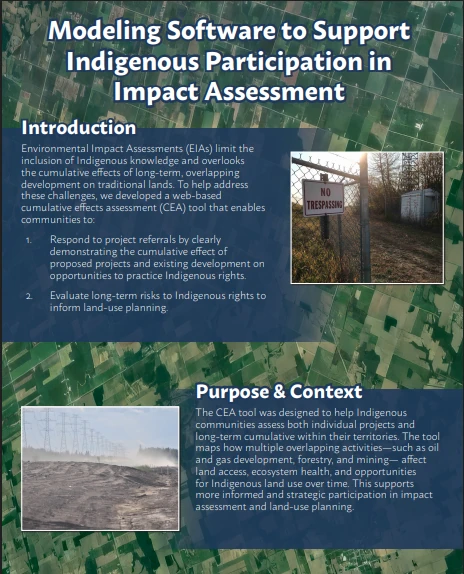
We work with communities to assess impacts of past, current, and future development to opportunities for Indigenous land uses such as the harvest of wildlife, fish, and plants. Assessments typically span very large regions to encompass traditional territories, and impacts are interpreted relative to natural baselines. We have worked with Indigenous communities in Alberta, British Columbia, Ontario, and Saskatchewan on cumulative effects assessments.

Two animated maps of an Alberta watershed running from 1900 to the present. The left map shows accessibility for Indigenous hunting shrinking as development spreads; the right shows opportunity for Indigenous harvest of moose declining alongside it.
Reconstruction of lost accessibility for Indigenous hunting (left) and opportunity for Indigenous harvest of moose (right) over the past century in an Alberta watershed. Prepared using ALCES Flow.

Selected work

Much of our work is confidential to the communities and clients who commission it. The projects below are a selection that we are able to discuss publicly.

Fort McKay Métis Nation Cumulative Effects Assessment and Toolkit

Battle River Cumulative Effects Study

Fort McKay Cumulative Effects Study

Published work

An assessment completed with the Fort McKay Métis Nation was presented at the 2025 Conference of the International Association for Impact Assessment in Bologna, Italy, and was recently published in the journal Environmental Management.
  1. Carlson, M., Straker, J., Berg, K., Bockstael, E., Borle, E., Bindle, L., Belisle, C., Bonnyman, M., Faichney, F., & Golden, D. (2025). Bringing Together Indigenous Knowledge and Simulation Modelling to Assess Cumulative Impacts to Indigenous Land Use in Northeastern Alberta, Canada. Environmental Management, 75(11), 2960–2976.
A boreal wetland and open water, with spruce forest along the shore.

Talk to us about your region

We build each ALCES site around the questions its organization needs to answer, so no two are alike. If this is close to your own work, we would be glad to hear about it. The demonstration sites on alces.ca are open to anyone with an account.